


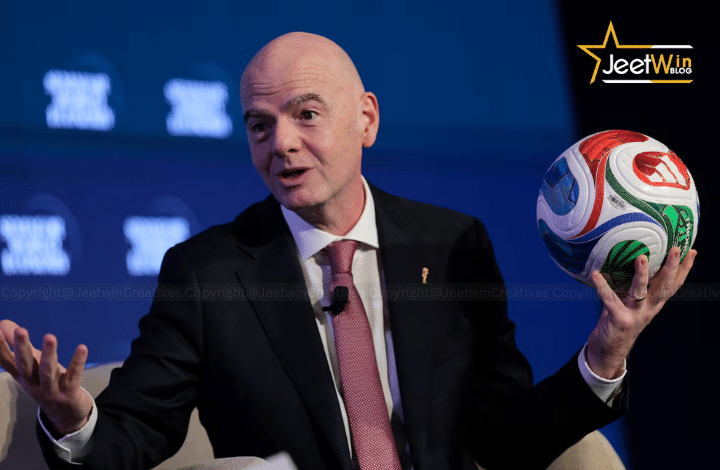
FIFA president Gianni Infantino has confirmed that football’s governing body will discuss expanding the men’s World Cup to 64 teams once the current 2026 tournament concludes. The United States, Canada, and Mexico are hosting this year’s edition, the first to feature 48 teams after growing from the previous 32-team format. A further expansion now appears to be under serious consideration.
Speaking to Swiss broadcaster Blue Sport, Infantino said the topic will come up in FIFA’s relevant committees after the tournament ends. He argued that a bigger World Cup gives more nations a genuine shot at qualifying, not just teams from Europe and South America. According to Infantino, rising standards across smaller football nations support the case for growth, and shutting them out removes their motivation to keep developing.
Why FIFA Is Weighing a 64-Team World Cup
The idea of a 64-team tournament is not new. South American confederation CONMEBOL first raised it in March 2025, pushing for the format to debut at the 2030 World Cup, which will mark the competition’s 100th anniversary.
CONMEBOL president Alejandro Domínguez met Infantino in New York in September, joined by officials from Argentina, Uruguay and Paraguay, to press the proposal further. Domínguez framed the expansion as a chance to make the tournament a shared global event rather than one limited to a handful of powerhouse nations.
A 64-team World Cup would nearly double the number of matches played compared with the 32-team era that ran from 1998 through 2022. That format produced 64 matches per tournament. This year’s 48-team World Cup will stage 104 matches in total, and a jump to 64 teams would push that figure to 128 games across the competition.
Opposition Remains Strong Within Football
Not all people within the game are behind the plan. Victor Montagliani, the President of Concacaf, went against the idea of increasing the number of teams from 32 to 64 when speaking to ESPN in April 2025 and said that such an increase would damage the football ecosystem in general, affecting national teams, club tournaments, leagues and even players. The same idea was expressed by Aleksander Čeferin, who serves as the UEFA president.
FIFA has already faced criticism this year over aspects of the expanded 48-team format, including scheduling and player fatigue during a longer, more physically demanding tournament. Adding another 16 teams would likely intensify those debates rather than settle them.
What Happens Next for the 2030 Tournament
There is no time frame in place for when the decision will eventually be reached, but Infantino says the discussion process is set to start after the conclusion of the 2026 World Cup in July. The 2030 tournament, which will see co-hosting in Spain, Portug
al, Morocco, Argentina, Paraguay, and Uruguay for some of the games, appears to be the likeliest one where a change can be implemented. FIFA will need buy-in from continental confederations before altering the format again so soon after the last increase.
For now, the current 48-team tournament continues to unfold in North America, with FIFA watching closely how it performs before committing to another expansion for the sport’s centenary edition.
For more sports news and updates, follow Yogame Blog!

